News The Importance of Sustainable Architecture for India and Jharkhand’s Future
India is entering a period of rapid construction. New housing, workplaces, educational institutions, healthcare facilities, commercial developments and public infrastructure are changing the physical character of cities and towns. The choices made during this expansion will influence how buildings perform, how much they cost to operate and how well they respond to changing environmental conditions.
This makes sustainable architecture more than a design preference. It is becoming a practical approach to creating buildings that use resources carefully, remain comfortable for occupants and deliver value throughout their useful life.
For Jharkhand, the subject has particular relevance. Ranchi and other growing urban centres are experiencing changes in land use, infrastructure demand, housing requirements and commercial development. The opportunity is to ensure that new construction contributes to long-term urban quality rather than creating avoidable environmental and operational pressures.
From Construction to Long-Term Performance
A building should not be judged only by its appearance or by the materials visible after completion.
Its environmental performance is influenced by decisions made throughout its life—from construction and material selection to energy consumption, water use, maintenance and eventual adaptation.
A sustainable building therefore seeks to achieve several outcomes at the same time:
This changes the question architects and developers ask. Instead of asking only “How should the building look?”, the conversation becomes “How should the building perform over time?”
Why India Needs Better-Performing Buildings
India's growing population, expanding cities and rising infrastructure requirements will create a substantial demand for new buildings.
If these buildings are designed without considering operational efficiency, resource consumption and future climate conditions, today's construction decisions can become tomorrow's long-term costs.
Energy-intensive buildings can place greater pressure on electricity infrastructure. Poor water management can increase freshwater demand. Inadequate drainage and landscape planning can intensify local runoff. Buildings that are difficult to maintain or adapt can also become economically inefficient as their needs change.
Sustainable architecture offers another direction: build well, consume intelligently and plan for the future.
This approach is relevant across housing, offices, schools, hospitals, hospitality, institutional buildings and public infrastructure.
The Indian Context: Tradition Meets New Technology
Sustainable architecture is not entirely new to India.
Traditional buildings often responded to local conditions through courtyards, verandas, shaded transition spaces, appropriate openings, locally available materials and layouts suited to regional lifestyles.
Contemporary architecture has access to additional tools: energy modelling, efficient mechanical systems, solar technologies, advanced materials, digital analysis and building-performance monitoring.
The opportunity lies in combining local architectural knowledge with contemporary engineering and technology rather than treating sustainability as an optional feature added at the end of a project.
Sustainable Design Is Also an Economic Decision
Environmental performance and financial performance are closely connected.
A building that consumes less electricity can reduce recurring operating expenditure. Durable materials can reduce replacement frequency. Efficient water systems can lower consumption and maintenance requirements. Good daylight and indoor environmental conditions can also contribute to more usable and comfortable spaces.
This is why sustainability should be considered through life-cycle value, rather than only through initial construction cost.
A lower-cost decision at the construction stage may not always remain the lower-cost decision over 10, 20 or 30 years.
For developers, institutions and building owners, this creates a stronger business case for considering performance early.
Jharkhand: A Regional Opportunity
Jharkhand's development presents its own set of requirements.
Ranchi is expanding as an administrative, educational, healthcare and commercial centre, while other cities and industrial areas continue to develop. New construction must therefore respond to local environmental conditions as well as changing patterns of urban growth.
For projects in Jharkhand, designers can consider:
The objective should not be to copy solutions developed for another city. A successful approach begins with understanding the project's location, purpose, users and constraints.
Policy Is Changing the Building Conversation
India's building-energy framework has been moving toward stronger performance requirements.
The Energy Conservation and Sustainable Building Code (ECSBC) 2024 represents a further development of India's approach to energy-conscious building design. Earlier provisions under the Energy Conservation Building Code (ECBC) established a foundation for improving the energy performance of applicable buildings.
Jharkhand has also notified its own ECBC framework. Such policies demonstrate a broader shift in the construction sector: energy performance is increasingly becoming part of the technical and regulatory discussion rather than remaining solely a voluntary design consideration.
Green-building systems such as GRIHA and IGBC provide additional frameworks through which projects can establish environmental objectives and evaluate performance.
For professionals, the direction is clear: sustainability increasingly needs to be considered alongside planning, engineering, construction and building operation.
A Look at Indira Paryavaran Bhawan
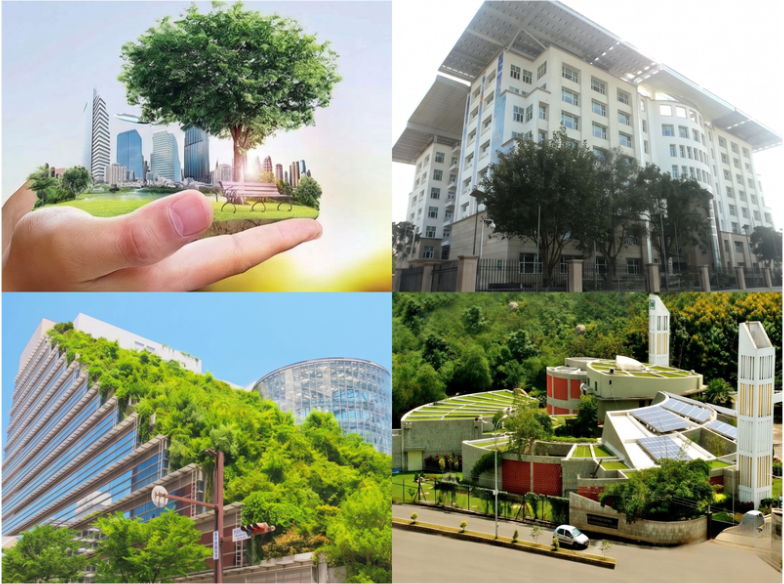
The Indira Paryavaran Bhawan in New Delhi provides a useful example of how sustainability can be translated into measurable building performance.
According to the GRIHA case study, the project includes a 930 kW solar photovoltaic system and achieved a 67.3% reduction in energy consumption against the GRIHA benchmark.
The significance of the project goes beyond individual technologies. It demonstrates the value of setting performance objectives and assessing whether a completed building actually delivers against them.
For projects in Jharkhand, the broader lesson is relevant: sustainable architecture should be evaluated not only through visual appearance or certification status, but through how effectively a building performs during operation.
Certification Is a Tool, Not the Final Objective
GRIHA and IGBC can provide useful assessment structures, but a certificate alone cannot determine how a building will perform throughout its lifetime.
Actual outcomes can be influenced by:
A project may achieve a rating and still require careful management after completion.
The stronger goal is therefore measurable, usable and maintainable buildings.
What Sustainable Architecture Can Mean for Ranchi
For Ranchi, sustainability can become part of a wider urban-development strategy.
Buildings should not be considered as isolated objects. Their relationship with roads, public areas, drainage, vegetation, neighbouring properties and community infrastructure can influence the performance of the wider environment.
Residential developments can benefit from efficient layouts and resource-conscious planning. Offices can focus on healthy and productive indoor environments. Educational and healthcare buildings can prioritise comfort, reliability and efficient operation. Public projects can demonstrate responsible resource use at a larger scale.
This creates an opportunity for sustainable architecture to contribute not only to individual buildings but also to the quality and resilience of growing urban areas.
The Role of Designers and Consultants
Achieving better building performance requires decisions across several professional disciplines.
Architects establish spatial and functional direction. Engineers address structural, electrical, mechanical and plumbing requirements. Landscape professionals contribute to outdoor environments and ecological performance. Interior designers influence material selection, lighting, comfort and user experience.
Coordination between these disciplines can prevent sustainability from becoming an isolated technical exercise.
The designer's role is also to balance competing requirements—construction budgets, aesthetics, user expectations, regulations, operational costs and environmental objectives.
The best solution is rarely the one with the most technology. It is the one that provides the right performance for the project's actual requirements.
ABIRIBA LIMITED: Designing for Long-Term Value
At ABIRIBA LIMITED, sustainability forms part of a wider design perspective covering architecture, engineering, interiors, workplace environments, urban planning and landscape design.
For projects in India and particularly in Jharkhand, the focus can be placed on making informed decisions about building performance, resource use, functionality, durability and future requirements.
Rather than treating sustainability as a decorative or technological addition, the objective is to connect environmental responsibility with design quality, technical performance and long-term value.
This perspective supports projects that are not only visually distinctive but also practical, efficient and capable of responding to changing needs.
The Way Forward for India and Jharkhand
India's next generation of buildings will need to respond to more than immediate construction requirements.
They will need to account for energy, water, materials, maintenance, occupant comfort, operating costs and changing environmental conditions.
Jharkhand has an opportunity to participate in this transition while continuing to address its housing, infrastructure, institutional and commercial needs.
The future of sustainable architecture is therefore not about making every building look the same or adding the same technologies to every project.
It is about making better decisions for each place, each building and each generation of users.
Key Takeaways
FAQs
What is sustainable architecture?
Sustainable architecture is an approach to designing buildings that use resources responsibly while supporting comfort, durability, efficiency and long-term environmental performance.
Why is sustainable architecture relevant to India?
Rapid urbanisation and construction are increasing demand for energy, water, materials and infrastructure. Better-performing buildings can help manage these demands while improving long-term building value.
What does sustainable architecture mean for Jharkhand?
It means developing building solutions that respond to local conditions, development patterns, resource requirements, budgets and the needs of communities.
Are sustainable buildings more expensive?
Not necessarily. Some strategies may require additional investment initially, but improved efficiency, durability and reduced operating costs can create value over the building's lifetime.
Are GRIHA and IGBC mandatory for every building?
No. Their applicability depends on project requirements, objectives and applicable regulations. They are assessment and certification frameworks rather than universal requirements for every building.
Can existing buildings be made more sustainable?
Yes. Existing buildings can be improved through measures such as energy assessments, efficient lighting and equipment, water-saving systems, improved controls, maintenance upgrades and appropriate building modifications.
References